

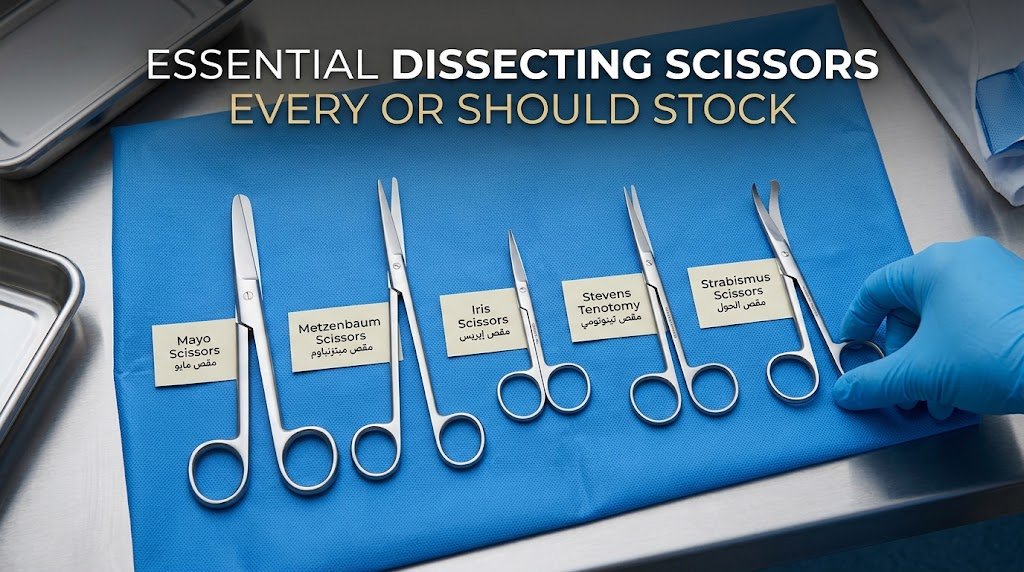
dissecting scissors types every OR should stock
Dissecting Scissors Types Every OR Should Stock: Clinical Protocols and Procurement Standards
Operating rooms (ORs) demand absolute precision, mechanical reliability, and structural resilience from their surgical instrumentation. Among cutting and mobilizing tools, selecting the right **dissecting scissors types every OR should stock** directly impacts surgical efficiency, reduces micro-vascular trauma, and eliminates preventable intraoperative delays.
Surgical dissection involves separating tissue planes through both sharp cutting and blunt mechanical spread. Using the wrong blade curvature, bevel angle, or alloy composition can lead to jagged tissue margins, accidental structural perforations, and premature instrument failure under repeated steam sterilization.
This comprehensive procurement guide details the critical dissecting scissors every modern operating room must maintain in its core surgical trays.
—
1. Metzenbaum Scissors: The Workhorse for Soft Tissue Dissection
dissecting scissors types every OR should stock
Metzenbaum scissors are the primary instrument for dissecting delicate anatomical structures across general surgery, thoracic operations, gynecology, and oncology.
### Anatomical Role & Design Geometry
* **Blade Architecture:** Characterized by longer, slender shanks relative to their light, curved blades with rounded (blunt/blunt) tips.
* **Clinical Purpose:** Designed for tissue plane mobilization via blunt spreading followed by clean division of non-fibrous structures (e.g., peritoneal flaps, intestinal mesentery, and pulmonary vessels).
* **OR Stocking Mandate:** Operating theaters must stock standard lengths (5.5 inches to 7 inches) for superficial and abdominal access, as well as extended deep-cavity variants (9 to 11 inches) for thoracic and pelvic surgery.
—
2. Mayo Scissors: Heavy Fascial and Tendinous Dissection
dissecting scissors types every OR should stock
When high-density connective tissue resists standard scissor blades, attempting to force delicate instruments results in spring deflection and pivot joint loosening.
Anatomical Role & Design Geometry dissecting scissors types every OR should stock
* **Blade Architecture:** Heavy, thick beveled blades anchored by a robust screw joint, available in straight or curved configurations.
* **Curved Mayo Scissors:** Utilized strictly for deep, fibrous tissue dissection such as the abdominal rectus sheath, linea alba, aponeuroses, and dense post-surgical adhesions.
* **Straight Mayo Scissors:** Primarily reserved for dividing heavy surgical sutures, surgical drains, and external mesh implants.
* **OR Stocking Mandate:** Sets of 5.5-inch, 6.75-inch, and 9-inch models constructed from high-tensile martensitic surgical steel (AISI 420).
—
3. Stevens Tenotomy & Plastic Dissecting Scissors: Fine Cavity Control dissecting scissors types every OR should stock
For delicate reconstructive maneuvers, tendon handling, and pediatric procedures, surgeons require instruments offering high leverage and fine tactile feedback.
Anatomical Role & Design Geometry dissecting scissors types every OR should stock
* **Blade Architecture:** Long, slender handles coupled to very short, tapered blades featuring blunt/blunt or semi-sharp profiles.
* **Clinical Purpose:** Dissecting in confined spaces, including hand tendons, peripheral nerves, strabismus eye corrections, and subtle facial flap elevations.
* **OR Stocking Mandate:** Curved profiles to facilitate multi-planar blunt dissection under loupe or microscope illumination.
—
4. Iris & Micro-Dissecting Scissors: Ultra-Fine Tissue Separation
Originally engineered for ophthalmic procedures, Iris scissors are now stocked universally across acute and specialized operative fields.
Anatomical Role & Design Geometry dissecting scissors types every OR should stock
* **Blade Architecture:** Compact overall length (typically 4.5 inches) with needle-sharp pointed tips and micro-beveled cutting edges.
* **Clinical Purpose:** Debridement of fine mucosal margins, ophthalmic microsurgery, vascular end-trimming, and delicate pediatric tissue division.
—
5. Potts-Smith Angled Scissors: Vascular & Deep Cavity Access
Cardiovascular, neurosurgical, and deep thoracic trays require specialized angled cutting capabilities.
### Anatomical Role & Design Geometry
* **Blade Architecture:** Slender, extended shanks terminating in blades angled at 25°, 45°, or 60°.
* **Clinical Purpose:** Longitudinal arteriotomy enlargement, coronary artery bypass grafting (CABG), and deep micro-vascular dissection where the surgeon’s hand must remain outside the direct optical axis.
—
6. Core OR Stocking Framework: Technical Specifications
| Dissecting Scissor Type | Target Anatomical Structure | Primary Blade Profile | Recommended Alloy Standard |
| :— | :— | :— | :— |
| **Metzenbaum** | Soft tissue, serosa, bowel mesentery | Curved blunt/blunt; long slender shanks | Tungsten Carbide (TC) gold-ring inserts |
| **Mayo** | Dense fascia, tendons, heavy scar tissue | Beveled curved or straight thick blades | Martensitic 420 surgical steel |
| **Stevens Tenotomy** | Fine tendons, pediatric tissues, nerves | Short curved blades, tapered tips | High-carbon stainless steel / TC |
| **Iris** | Mucosa, delicate skin edges, micro-vessels | Ultra-fine sharp/sharp blades (4.5″) | Hardened mirror-passivated steel |
| **Potts-Smith** | Arteriotomy, vascular lumens | 45° angled blades with probe-tipped guide | Medical-grade 316L / 420B stainless steel |
—
7. Quality Metallurgy: Tungsten Carbide vs. Standard Stainless Steel
OR inventory managers and theater coordinators must distinguish between standard reusable tools and high-durability instruments:
* **Tungsten Carbide (TC) Inserts:** Indicated by gold-plated handles, TC-lined jaws maintain cutting edge sharpness five to six times longer than standard steel, withstanding high autoclave cycles without micro-nicking.
* **SuperCut Blade Configurations:** Combining a razor-ground upper blade with a micro-serrated lower blade prevents slippery tissue extrusion during closure, yielding smooth, precise cuts.
* **Glare-Free Finishes:** Satin, matte, or black ceramic coatings reduce glare under high-intensity OR lighting, mitigating surgeon eye fatigue.
—
8. Certified Surgical Instrumentation Supply in Egypt
Equipping hospital operating theaters with high-tolerance surgical instruments demands proven sourcing partners. **Alreda Medical** supplies university hospitals, specialized surgical centers, and private clinics across Egypt with international-grade surgical instruments.
Headquartered in the medical commercial hub of Kasr El Aini, Cairo, Alreda Medical provides full sets of dissecting scissors manufactured to strict European CE mark and ISO 13485 standards. Backed by extensive local warehouse stock, immediate nationwide delivery, and a verified replacement warranty against mechanical and metallurgical defects, we ensure your surgical suites operate without compromise.
For institutional catalog requests and wholesale procurement inquiries, visit our showroom at **31 El Rashidy St, Kasr El Aini, Cairo** or connect directly with our surgical equipment team via WhatsApp (+201156644476).
For trusted guidance on surgical safety, see the WHO Surgical Safety Checklist.
Frequently Asked Questions (FAQ)
1. What is the fundamental difference between Metzenbaum and Mayo scissors in surgery?
Metzenbaum scissors feature long, slender shanks and lightweight, blunt/blunt curved blades engineered for gentle dissection and spreading of delicate soft tissues (such as bowel mesentery and peritoneum) without causing structural tears. In contrast, Mayo scissors possess heavy, beveled blades and a robust screw joint designed to cut through dense, high-resistance fibrous tissues, such as the abdominal rectus sheath, linea alba, and thick fascia.
2. Why do hospitals and operating rooms prefer gold-handled dissecting scissors?
Gold handles or rings designate that the scissor blades are reinforced with Tungsten Carbide (TC) inserts. Tungsten carbide is approximately five times harder than standard surgical stainless steel; this reinforcement preserves razor-sharp cutting edges for significantly longer periods and resists pitting or premature dulling across hundreds of autoclave steam sterilization cycles.
3. Which dissecting scissors are mandatory for cardiovascular and thoracic surgical sets?
Cardiovascular and thoracic sets must include extended-length Metzenbaum scissors (9 to 11 inches) for deep cavity access within the mediastinum and pleural spaces, alongside Potts-Smith angled scissors (commonly 25°, 45°, or 60° angles) featuring a probe-pointed lower blade tip to safeguard the arterial intima during arteriotomy and vessel extensions.
4. Can Metzenbaum or Mayo dissecting scissors be used to cut surgical sutures?
Metzenbaum scissors must never be used to cut surgical sutures or drains, as the synthetic fibers cause immediate micro-nicking and rapid dulling of their delicate cutting edges. While straight Mayo scissors can cut heavy sutures in emergency settings, operating rooms should always preserve dissecting instruments by providing dedicated suture scissors (such as standard nurse or operating scissors) on the sterile field.








Leave a Reply