

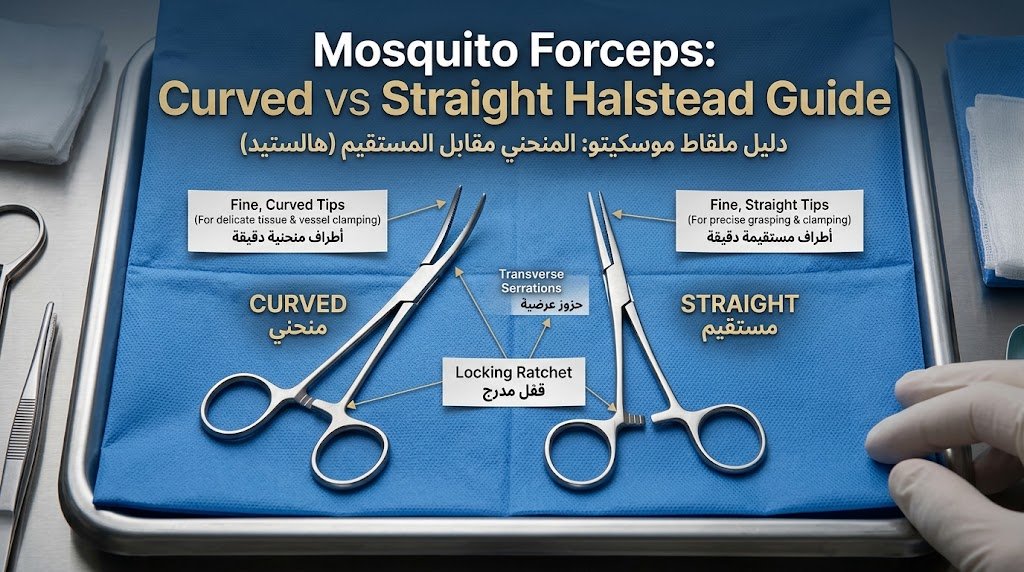
curved vs straight Halstead Mosquito forceps guide
curved vs straight Halstead Mosquito forceps guide: The Complete Clinical and Procurement Guide
In microsurgical suites, ophthalmic suites, plastic surgery, and general operative theaters, controlling hemorrhage in delicate vascular zones is paramount. Among precision hemostats, the **Halstead Mosquito forceps** stands out as an indispensable surgical instrument. However, deciding between curved and straight configurations directly dictates surgical ergonomics, field visibility, and vascular safety.
Understanding the mechanical distinctions, serration tolerances, and application vectors in the **curved vs straight Halstead Mosquito forceps guide** empowers surgical staff and hospital procurement officers to optimize operative trays and reduce surgical tissue trauma.
—
1. Architectural Anatomy of Halstead Mosquito Forceps
Pioneered by Dr. William Stewart Halstead, the Mosquito forceps is engineered specifically to occlude micro-vessels and hold minute anatomical tissues without crushing fragile vascular intima:
* **Overall Length:** Standardized at 5.0 inches (12.5 cm) or 5.5 inches (14.0 cm), offering superior tactile leverage in confined workspaces.
* **Jaw Design:** Fine, ultra-tapered tips featuring full-length transverse serrations across the entire inner jaw face.
* **Box-Lock Hinge Joint:** High-precision flush screw joint engineered to eliminate lateral play (jaw yaw) during occlusion.
* **Ratchet Mechanism:** Multi-step interlocking ratchet on the finger rings providing calibrated, step-by-step clamping pressure.
—
2. Curved Halstead Mosquito Forceps: Maneuverability & Sightline Optimization
Curved Halstead Mosquito forceps are engineered specifically for operative fields where direct vertical access is restricted or where continuous visualization past the instrument tip is vital.
Clinical Utility & Maneuver Vectors curved vs straight Halstead Mosquito forceps guide
* **Precise Deep Hemostasis:** The distal arch allows surgeons to direct the tips underneath tissue planes to clamp bleeding arterioles without occluding the primary visual axis.
* **Gentle Blunt Spreading:** By inserting the curved jaws closed and releasing the ratchet along natural fascia, surgeons separate microscopic fascial layers around peripheral nerves.
* **Obscurity Prevention:** The curvature prevents the instrument’s shanks and the surgeon’s hand from obstructing microscope or loupe field of view in microvascular anastomosis.
—
3. Straight Halstead Mosquito Forceps: Axial Traction & Tagging
Straight Halstead Mosquito forceps emphasize direct axial alignment, high clamping shear strength, and rigid trajectory control.
Clinical Utility & Maneuver Vectors curved vs straight Halstead Mosquito forceps guide
* **Suture Tagging & Traction:** Frequently employed as “suture tags” or “mosquito boots” (when tipped with soft silicone tubing) to grasp fine monofilament sutures (5-0 to 8-0) without kinking or weakening the polymer tensile strength.
* **Superficial Vascular Occlusion:** Optimal for clamping superficial bleeders in dermal margins, cutaneous incisions, and open wound debridement where access is linear.
* **Pediatric and Hand Interventions:** Provides direct, non-deviated tactile feedback when tracking vertical anatomical structures in pediatric orthopedic and tendon reconstructions.
—
4. Mechanical Comparison: Curved vs. Straight Halstead Mosquito Forceps
| Engineering Parameter | Curved Halstead Mosquito Forceps | Straight Halstead Mosquito Forceps |
| :— | :— | :— |
| **Primary Functional Intent** | Microvascular hemostasis & blunt spreading | Suture tagging & superficial linear clamping |
| **Field Line of Sight** | Unobstructed; arches away from line of sight | Linear; aligned along the insertion axis |
| **Optimal Surgical Fields** | Deep cavities, plastic surgery, ENT, neurosurgery | Cutaneous surgery, suture management, hand surgery |
| **Jaw Profile** | Continuous gentle radial curve to tip | Linear straight profile with fine tapered tip |
| **Tip Intermeshing** | Transverse serrations to the extreme apex | Uniform opposing horizontal serrations |
—
5. Metallurgy, Passivation, and OR Procurement Standards curved vs straight Halstead Mosquito forceps guide
Sterilization turnover and repeated chemical cleaning challenge surgical stainless steel integrity. Hospital procurement teams must verify the following manufacturing standards:
1. **Martensitic Stainless Steel (AISI 410 / 420):** Offers superior tensile strength and edge retention, preventing ratchet deformation over thousands of autoclave cycles.
2. **Certified Chemical Passivation:** Complete nitric or citric acid bath passivation removes free surface iron, creating a chromium oxide protective shield against pitting corrosion.
3. **Glare-Reducing Matte/Satin Finish:** Prevents reflective glare under high-lumen surgical LED operating lights.
4. **Tungsten Carbide (TC) Jaw Options:** Gold-ring models with micro-serrated TC inserts resist wear when repeatedly grasping metal surgical needles or traction wire.
—
6. Sourcing Hospital-Grade Halstead Forceps in Egypt
Reliable operative outcomes begin with uncompromised manufacturing standards. **Alreda Medical** equips Egyptian university hospitals, surgical centers, and private specialty practices with European-standard surgical instruments.
Based in Kasr El Aini, Cairo, Alreda Medical provides comprehensive inventories of curved and straight Halstead Mosquito forceps, complete hemostatic sets, and vascular instruments certified to ISO 13485 and CE mark standards. With immediate stock availability, verified replacement warranties, and specialized institutional B2B support, we safeguard surgical precision.
To request hospital catalogs or wholesale quotations, visit our Kasr El Aini showroom at **31 El Rashidy St, Cairo**, or contact our medical procurement specialists directly via WhatsApp (+201156644476).
For trusted guidance on surgical safety, see the WHO Surgical Safety Checklist.
Frequently Asked Questions (FAQ)
1. What is the primary difference between curved and straight Halstead Mosquito forceps?
Curved Halstead Mosquito forceps feature an arched tip designed to access and clamp bleeding micro-vessels in deep cavities without obstructing the surgeon’s direct line of sight. Straight Mosquito forceps are linear instruments primarily utilized for suture tagging and controlling superficial bleeders along flat, cutaneous margins.
2. Can Halstead Mosquito forceps be used for heavy vessel clamping?
No. Halstead Mosquito forceps are strictly engineered for microvascular hemostasis and delicate tissues. Applying them to large arteries or heavy fibrous structures can spring the box-lock hinge, strip the fine transverse serrations, and cause permanent jaw misalignment. For heavier vessels, Crile or Kelly forceps should be utilized.
3. What does “suture tagging” with straight Mosquito forceps mean?
In complex surgical procedures, surgeons use straight Mosquito forceps to grasp and organize long monofilament suture ends. Often, plastic or silicone sleeves (“suture booties”) are slipped over the jaws to prevent the metal serrations from fraying or weakening the suture material.
4. How can sterile processing teams verify Mosquito forceps jaw alignment?
Close the forceps gently to the first ratchet tooth and hold the tips against a light source under magnification. The opposing transverse serrations must intermesh cleanly without lateral gap or tip overlap, and the ratchet must not spring open upon a light tap against a table.





Leave a Reply