

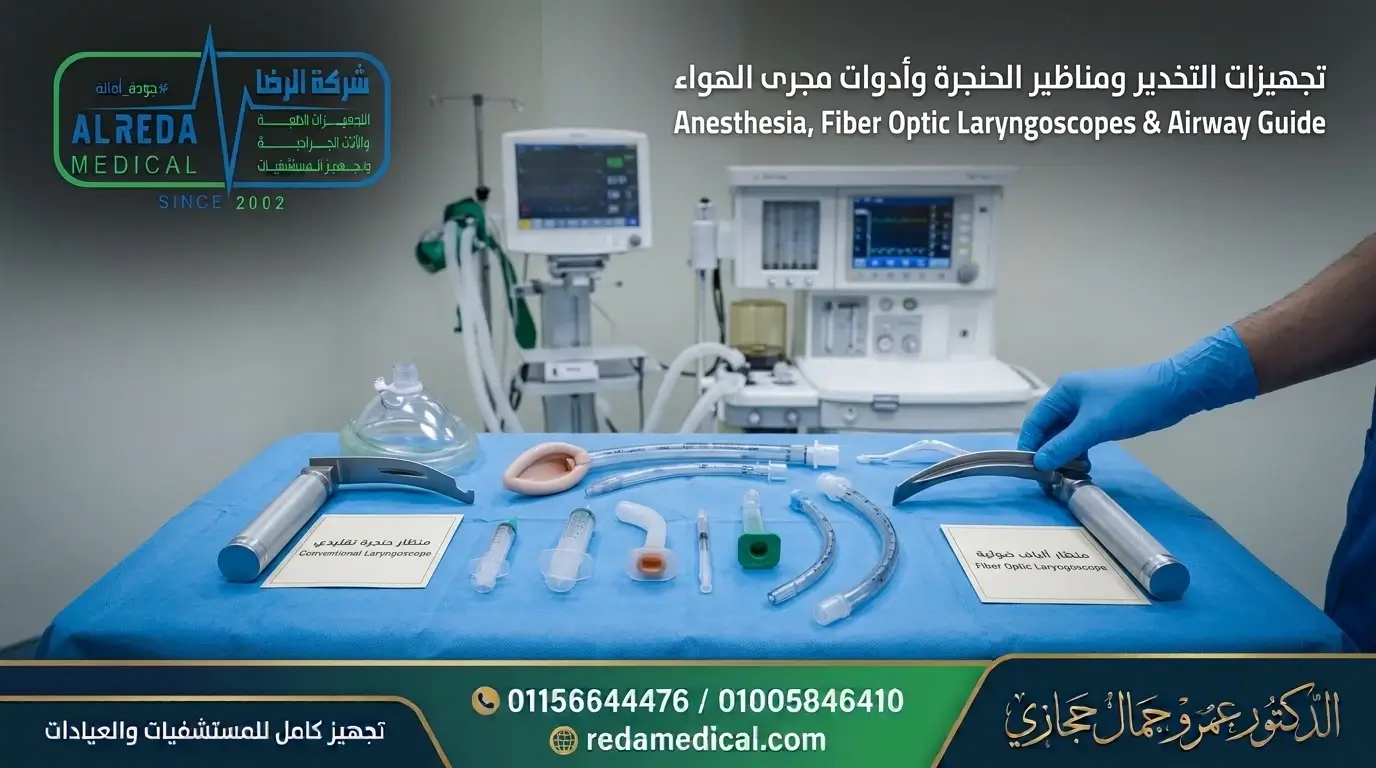
The Definitive Guide to Anesthesia Equipment & Fiber Optic Laryngoscopes: Clinical Specs & Hospital Sourcing
The Definitive Guide to Anesthesia Equipment & Fiber Optic Laryngoscopes: Clinical Specs & Hospital Sourcing
Anesthesia equipment and fiber optic laryngoscopes serve as the primary life-saving tools in operating theaters, emergency departments, and intensive care units (ICUs). During critical endotracheal intubation, anesthesiologists rely on brilliant shadow-free illumination, rigid blade-to-handle locking, and uninterrupted sterilization durability.
With over 25 years of industry leadership since 2002, and under the executive guidance of Dr. Amr Gamal Hegazy (Chairman of the Board of Alreda Medical For Surgical Instruments in Egypt and Dubai), Alreda Medical (ALREDA MEDICAL) has compiled this technical reference to assist anesthesiologists, ICU directors, and hospital procurement teams in sourcing ISO 13485, CE, and ISO 7376-certified airway management instruments.
For trusted guidance on surgical safety, see the WHO Surgical Safety Checklist.
1. Engineering Comparison: Fiber Optic vs. Conventional Laryngoscopes
Selecting between cold-light fiber optic systems and standard bulb-on-blade laryngoscopes directly impacts patient safety, illumination brightness, and CSSD sterilization turnaround:
| Evaluation Criteria | Fiber Optic Laryngoscope (Green System – ISO 7376/3) | Conventional Laryngoscope (Standard – ISO 7376/1) |
| Light Source Location | High-intensity LED/Xenon bulb housed inside the handle; light transmits via an enclosed fiber optic bundle | Miniature vacuum/LED lamp screwed directly onto the distal blade tip |
| Illumination & Thermal Safety | Ultra-bright cool light (up to 15,000 Lux) with zero risk of thermal mucosal burns | Moderate illumination; distal bulb can warm up during prolonged intubation |
| Autoclave 134°C Durability | Superior steam sterilization resistance; no exposed electrical contacts or bulbs on the blade | Requires bulb removal prior to autoclaving to prevent contact corrosion |
| Clinical Safety Profile | Maximum safety; eliminates any risk of a loose bulb detaching inside the patient’s airway | Requires pre-use verification of bulb tightness before every procedure |
| Universal Compatibility | Fully compliant with international Green System (ISO 7376/3) standards | Compatible with standard hook-on handles for routine clinical setups |
2. Laryngoscope Blade Geometries & Airway Management Instruments and Fiber Optic Laryngoscopes
All laryngoscope blades supplied by Alreda Medical For Surgical Instruments are crafted from non-magnetic AISI 304 surgical stainless steel with a satin anti-glare finish:
| Functional Category | Essential Certified Instruments & Sizes | Primary Clinical Application |
| Macintosh Curved Blades | Full range from Size 0 to Size 5 (pediatric through large adult) | Gold-standard curved blade for indirect epiglottic elevation in adult intubation |
| Miller Straight Blades | Full range from Size 00 (premature/neonatal) to Size 4 | Ideal for neonates, infants, and anterior airways requiring direct epiglottic lift |
| McCoy Flexi-Tip Blades | Sizes 2, 3, and 4 featuring an articulated lever-controlled tip | Engineered for difficult airways to elevate the epiglottis without dental leverage |
| Magill Forceps & Airway Tools | Magill Catheter Introducing Forceps (Pediatric & Adult) and Mouth Gags | Guiding nasotracheal tubes into the glottis and emergency foreign-body removal |
| Turnkey Crash-Cart Sets | Complete Fiber Optic LED Laryngoscope Kits (2 Handles + 4–5 Blades in case) | Immediate readiness for OR suites, ambulances, and hospital crash carts |
3. Why Leading Anesthesia & ICU Departments and Fiber Optic Laryngoscopes Partner with Alreda Medical (6 Pillars of Trust)
Ready Stock & Immediate Delivery: Extensive inventory of fiber optic LED laryngoscope sets, individual Macintosh/Miller blades, and Magill forceps across Cairo (Kasr El Aini), Giza (Mohandessin – Sphinx Square), and Dubai (UAE).
ISO 7376 Universal Compatibility: Guaranteed mechanical and optical compatibility across handles, blades, and replacement LED lamps.
Direct Replacement Warranty: Immediate replacement guarantee against any manufacturing defects or fiber-bundle light loss.
Officially Coded & Accredited: Registered supplier with the Egyptian Authority for Unified Procurement (UPA) and fully compliant with ISO 13485 and CE standards.
Autoclave 134°C Certified: Enclosed fiber optic bundles engineered to withstand repeated high-temperature steam sterilization.
25+ Years of Proven Expertise & E-Invoicing: Trusted by hospitals and emergency networks since 2002 with certified electronic tax invoicing.
Request Our Anesthesia & Airway Catalog or a Custom B2B Quote:
Contact our institutional sales team via Phone/WhatsApp at
+201156644476/+201005846410or review our Hospital Surgical Instruments Procurement Guide and Quality & Certifications.
4. Frequently Asked Questions Fiber Optic Laryngoscopes (FAQ)
What is the clinical difference between a Macintosh Blade and a Miller Blade?
A Macintosh blade is curved and placed into the vallecula to indirectly lift the epiglottis—making it standard for adults—whereas a Miller blade is straight and designed to directly lift the epiglottis, making it preferred for neonates, infants, and patients with anterior airways.
Can fiber optic laryngoscope blades be sterilized in a steam autoclave?
Yes. Enclosed fiber optic blades supplied by Alreda Medical are engineered to withstand repeated 134°C steam autoclave cycles without optical degradation (always remove batteries and the LED lamp from the handle before autoclaving).
What is the purpose of Magill Forceps in an anesthesia kit?
Magill forceps feature an angled double-bend profile that keeps the clinician’s hand out of the direct line of sight, enabling precise guidance of nasotracheal tubes through the vocal cords or removal of pharyngeal foreign bodies.


Leave a Reply